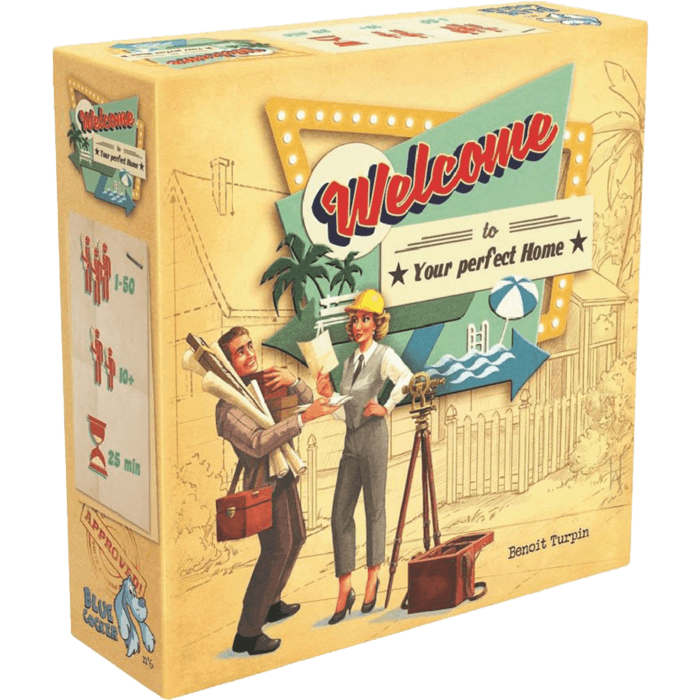
Blue Cocker • 2018
Three cards are flipped each turn. Every card shows a number and an action. All players simultaneously choose one of the three combinations and write it on their personal suburb map — a set of three streets where you're placing houses in ascending order. The numbers go onto houses. The actions let you build pools, parks, fences (to zone estates), or duplicate numbers. You're trying to fill streets, build specific estate configurations, and hit city plan bonus goals before other players do. Because everyone works from the same three cards, the game plays in exactly the same time whether there are 2 players or 50. There are no turns. No waiting. Everyone picks, writes, and moves on. The decisions are interesting without being stressful. You're balancing short-term opportunities against long-term street layout. Put a 7 too early on a street and you've blocked half the future options. But if nobody else has scored that city plan yet, maybe it's worth the risk. No direct interaction. You can't affect anyone else's board. Some groups see this as a feature — there's no blocking, no "take that", just parallel puzzle-solving. Others might find it too solitary. It works best in groups where people are comfortable chatting while playing. It's a "flip and write" game with a 1950s American suburb theme. The aesthetic is clean and retro. Dry-erase sheets mean infinite replays. There are also expansion packs that swap the theme (Vegas, Easter Island) and add new mechanics.
Answer a few questions to find the perfect board game for your group.
👉 Find the perfect game instead# How to Host a Game Night for 10+ People Hosting 10 or more people is a totally different beast than a standard 4-player game night. You c…
# Best Board Games That Scale to Any Number of Players Sometimes you don't know if 4 people are showing up or 14. Friends drag along plus-o…
# Short Board Games for Big Groups (Under 30 Minutes) The math of board games is usually brutal: more players equals a longer game. A tight…