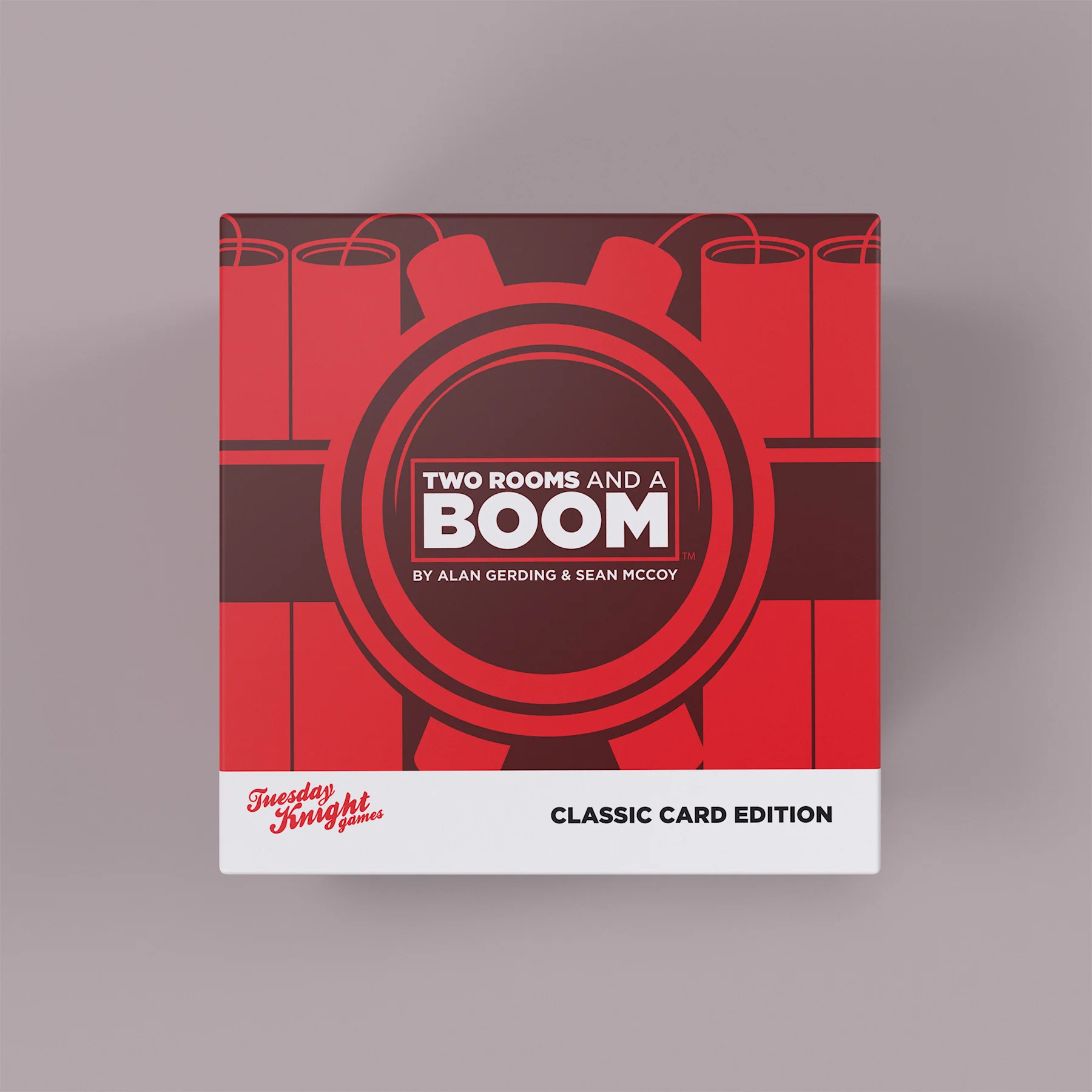
Tuesday Knight Games • 2013
Split the group into two physical rooms (or two sides of a large room). Team Blue has a hidden President. Team Red has a hidden Bomber. If the Bomber and President are in the same room when the timer runs out, Red wins. If they're in different rooms, Blue wins. Each timed round (the game lasts three rounds, getting shorter each time), the leaders of each room select "hostages" to trade to the other room. This is the whole game: negotiation, bluffing, and hostage selection. Should you reveal your role to the room leader? Can you trust the leader? Is the person the other room sent over actually defecting, or are they a plant? Extra role cards add abilities — the Spy can swap teams, the Gambler picks a side and wins with them, the Doctor can protect people, the Engineer can defuse the bomb. With more players, more role cards get added, which creates increasingly chaotic and strategic games. It's a social game in the truest sense. You're walking around, having private conversations, forming alliances, and trying to deduce who's on which team. There's no board, no cards on a table — just people talking in rooms. Plays 6-30. Below 10, it's tense and personal. Above 15, it becomes a large-scale social experiment where misinformation spreads like wildfire. The game is strictly timed at 15 minutes total. You always know when it ends. Setup is the biggest barrier. You need two rooms, a moderator, and time to distribute and explain roles. It's best at events, conventions, or house parties rather than casual game nights.
Answer a few questions to find the perfect board game for your group.
👉 Find the perfect game instead# How to Host a Game Night for 10+ People Hosting 10 or more people is a totally different beast than a standard 4-player game night. You c…
# Best Social Deduction Games for Big Groups If your group is growing past the six-player mark, social deduction games are often the first …